Introduction
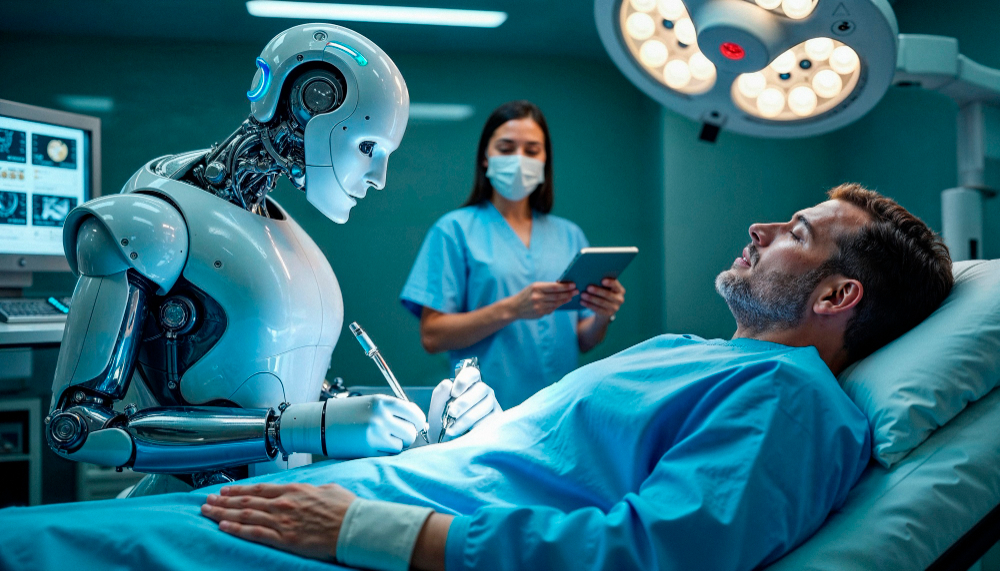
Not long ago, the idea of a robot performing surgery sounded like science fiction. Today, robotic systems are a routine sight in operating rooms around the world — quietly assisting surgeons in procedures that demand precision, stability, and control beyond human limits.
From delicate cardiac operations to intricate brain surgeries, robot-assisted surgery has become one of the most transformative innovations in modern medicine. Yet, it’s not about replacing doctors — it’s about enhancing their hands, vision, and precision with technology that never trembles.
Welcome to the era where humans and machines collaborate in the operating room — and together, redefine what’s surgically possible.
1. What Is Robotic Surgery?
Robotic surgery, or robot-assisted surgery, uses computer-controlled instruments guided by a human surgeon. These systems translate the surgeon’s hand movements into micro-movements of surgical tools, allowing for greater precision, flexibility, and control than traditional manual techniques.
The surgeon typically operates from a console equipped with 3D magnified vision and intuitive controls. The robot’s arms — holding instruments or cameras — replicate the surgeon’s motions in real time, often at a microscopic level of accuracy.
2. The Evolution of Surgical Robots
The story of surgical robotics began in the late 1980s, but the real revolution came with Intuitive Surgical’s da Vinci System, approved by the FDA in 2000.
Since then, robotic surgery has expanded dramatically. Systems like:
- da Vinci Xi and SP (Intuitive Surgical) – the most widely used platforms in general and urologic surgeries.
- Mako SmartRobotics (Stryker) – assists orthopedic surgeons in hip and knee replacements.
- ROSATM (Zimmer Biomet) – enables precise spine surgery.
- CorPath GRX (Siemens Healthineers) – used in cardiovascular interventions, even allowing remote robotic surgeries.
By 2025, over 2 million robotic procedures are expected to be performed annually worldwide.
3. How Robots Assist in Complex Surgeries
a. Precision Beyond Human Limits
Robotic systems can make movements as small as one millimeter — far more stable than even the steadiest human hand. This precision is critical in surgeries involving delicate nerves, blood vessels, or microscopic tissue.
b. Enhanced Visualization
High-definition, 3D magnified cameras give surgeons a superior view of the surgical site — up to 10x greater detail than the naked eye. This allows for safer dissections and better identification of anatomical structures.
c. Minimally Invasive Access
Through tiny incisions, robotic arms can reach areas of the body that are difficult to access in traditional open surgery. This results in less trauma, reduced scarring, and faster recovery.
d. Greater Dexterity in Confined Spaces
In areas like the pelvis or chest cavity, robotic arms can rotate and bend far beyond human wrists, offering 360-degree range of motion.
e. AI and Automation Integration
Modern robots are becoming AI-enhanced assistants. Machine learning algorithms analyze surgical videos, predict the next step, and even provide real-time guidance or alerts — helping surgeons make better decisions mid-procedure.
4. Examples of Robot-Assisted Surgeries
Cardiac Surgery
Robotic systems can perform coronary artery bypass or valve repair with unmatched precision. Surgeons use robotic tools to navigate around beating hearts through small incisions — minimizing the need for open-chest surgery.
Neurosurgery
In brain operations, where millimeters can mean everything, robots assist in electrode placement, tumor resections, and spinal alignment. Systems like ROSA Brain help neurosurgeons perform procedures for epilepsy and Parkinson’s disease with pinpoint accuracy.
Orthopedic Surgery
Robotic platforms such as Mako create 3D models of a patient’s bone structure, enabling perfectly fitted implants for knee and hip replacements. The AI adapts to real-time bone movement during surgery.
Urology and Gynecology
The da Vinci system is a game-changer in prostatectomies and hysterectomies, offering shorter recovery times and fewer complications compared to traditional approaches.
5. The Human-Robot Partnership
Despite the hype, it’s essential to remember: robots don’t operate independently. Every incision, cut, and stitch is still directed by a skilled human surgeon.
The robot acts as an extension of the surgeon’s abilities, filtering out hand tremors, scaling motion, and offering enhanced vision — but not making autonomous decisions.
This collaboration is the perfect blend of human intuition and machine precision — where experience meets engineering.
6. Benefits of Robotic Surgery
- Smaller incisions and less pain
- Reduced blood loss and scarring
- Shorter hospital stays and faster recovery
- Greater consistency and reproducibility
- Improved access to hard-to-reach anatomy
For patients, these advantages translate into fewer complications and faster returns to normal life.
7. Challenges and Limitations
While revolutionary, robotic surgery still faces hurdles:
- High Costs: Robotic systems can cost $1–2 million, with additional expenses for maintenance and disposable instruments.
- Training Requirements: Surgeons must undergo specialized training to master robotic platforms.
- Limited Tactile Feedback: Current systems lack full sensory feedback, meaning surgeons rely more on visuals than touch.
- Access Inequality: Not all hospitals — especially in developing regions — can afford robotic systems.
Researchers are now exploring haptic feedback, AI-assisted learning, and remote robotic surgery to overcome these barriers.
8. The Future: Smarter, More Autonomous, and Connected
The next generation of surgical robots will be even more intelligent and integrated.
Future developments include:
- AI-guided automation: Robots that assist in suturing or tissue differentiation automatically.
- Remote telesurgery: Surgeons operating across continents via 5G networks.
- Miniaturized robots: Microscopic “surgical swarms” capable of repairing tissue internally.
- AR/VR Integration: Surgeons using augmented reality to visualize anatomy in real time.
Eventually, surgical robots may become intelligent partners — analyzing data, anticipating needs, and continuously learning from millions of previous procedures.
Conclusion
Robots in surgery represent a profound leap in medical technology — not because they replace surgeons, but because they empower them.
By merging human skill with robotic precision, modern medicine is achieving feats once thought impossible — saving lives with smaller incisions, fewer errors, and faster recoveries.
As AI, robotics, and connectivity advance, the operating room will continue to evolve — becoming not just smarter, but safer and more human-centered than ever before.
In the end, the scalpel may still be guided by a human hand — but behind it will be the steady, tireless precision of a robot.






Leave a Reply